Idioms For Kids – Teaching idioms for kids is one of the most fun ways to help young learners grow their vocabulary and understand creative language. Idioms are expressions that don’t mean exactly what they say — which makes them silly, surprising, and exciting for children to explore.
In this article, you’ll discover a complete list of 150+ idioms for kids. Some funny idioms, most common idioms for kids, simple kids’ idioms, and dozens of examples with meanings and sentences to make learning enjoyable.
Idiom Definition For Kids
Idioms are short expressions whose meanings don’t match the literal words. Kids in the U.S. and Canada hear idioms in school, at home, and in books. They make language more fun, creative, and expressive.
Example:
- “It’s raining cats and dogs” doesn’t mean animals are falling — it means it’s raining very heavily.
Why Idioms Matter in Children’s Learning?
Idioms help children in:
- Understand expressions in books, shows, and daily conversations
- Think creatively about language
- Improve vocabulary and reading comprehension
Benefits of Teaching Idioms to Kids
- Helps Boost Vocabulary – Kids learn new words and phrases that appear in stories, songs, and conversations.
- Improves Reading & Comprehension Skills – Idioms make stories richer and more expressive.
- Encourages Creative Thinking – Children start imagining beyond the literal meaning of words.
Idiom Examples for Kids – A Quick Reference
Here are some of the simplest idiom examples for kids who are just beginning to learn figurative language:
- “A piece of cake” — something very easy
- “Hit the hay” — go to bed
- “Couch potato” — someone who watches TV and is very lazy
- “Break a leg” — good luck
- “Spill the beans” — tell a secret
Simple Idiom examples for kids in sentences:
- “Math homework was a piece of cake today.”
- “I’m tired — I’m going to hit the hay.”
- “Don’t be a couch potato; let’s play outside.”
- “Break a leg at your recital!”
- “Who spilled the beans about the surprise party?”
These short examples help kids learn idioms in a context they recognize.
Funny Idioms For Kids

A Piece of Cake
This idiom means something is very easy to do.
Example: The math homework was a piece of cake.
Break the Ice
This means to start talking or help people feel comfortable.
Example: We played a silly game to break the ice at school.
Hold Your Horses
This means to wait or slow down.
Example: Hold your horses — we’re not ready to leave yet!
Hit the Hay
This means to go to sleep.
Example: I’m tired — I’m going to hit the hay early.
Couch Potato
This describes someone who sits around and doesn’t do much.
Example: Don’t be a couch potato — let’s go outside and play.
When Pigs Fly
This means something will never happen.
Example: He’ll clean his messy room when pigs fly.
It’s Raining Cats and Dogs
This means it’s raining really hard.
Example: We can’t walk to school — it’s raining cats and dogs!
Spill the Beans
This means to tell a secret.
Example: Who spilled the beans about the surprise?
The Last Straw
This means the final problem that makes someone upset.
Example: Losing my backpack was the last straw today.
Monkey Business
This means silly or naughty behavior.
Example: Stop the monkey business and finish your homework.
Cry Over Spilled Milk
This means getting upset over something small.
Example: It’s okay — don’t cry over spilled milk.
You Crack Me Up
This means someone makes you laugh a lot.
Example: His funny faces always crack me up.
Under the Weather
This means feeling sick.
Example: I stayed home because I felt under the weather.
Butter Up
This means being extra nice to someone to get something.
Example: Are you trying to butter me up so you can watch more TV?
In Hot Water
This means being in trouble.
Example: She was in hot water for breaking the vase.
Bite Your Tongue
This means stopping yourself from saying something.
Example: I had to bite my tongue so I wouldn’t argue.
Not My Cup of Tea
This means something you don’t enjoy.
Example: Running isn’t my cup of tea, but I love biking.
A Fish Out of Water
This means feeling uncomfortable or out of place.
Example: I felt like a fish out of water at my new school.
Don’t Have a Cow
This means don’t get upset or overreact.
Example: Don’t have a cow — it’s just a small mistake.
That Ship Has Sailed
This means it’s too late or the chance is gone.
Example: The bus already left — that ship has sailed.
Animal Idioms for Kids

Busy as a Bee
This idiom means being very busy and active.
Example: She was as busy as a bee finishing her science project.
Let the Cat Out of the Bag
This means revealing a secret.
Example: Someone let the cat out of the bag about the surprise party.
Cry Wolf
This idiom means asking for help when you don’t really need it.
Example: If you cry wolf too many times, people won’t believe you.
Copycat
This means someone who copies another person.
Example: Don’t be a copycat — use your own creative ideas.
Pig Out
This means to eat a lot of food.
Example: We pigged out on pizza during movie night.
Elephant in the Room
This refers to a big problem everyone knows about but avoids discussing.
Example: The broken window was the elephant in the room.
Wild Goose Chase
This means a long search for something that’s hard to find.
Example: Looking for my tiny toy car felt like a wild goose chase.
Fish Out of Water
This means feeling out of place or uncomfortable.
Example: I felt like a fish out of water on my first day at a new school.
Top Dog
This idiom means being the leader or best at something.
Example: She became the top dog after winning the spelling bee.
Ants in Your Pants
This means being very restless or unable to sit still.
Example: He had ants in his pants waiting for recess.
Let Sleeping Dogs Lie
This means to leave something alone so it doesn’t cause trouble.
Example: Just let sleeping dogs lie and don’t bring up the old argument.
Straight From the Horse’s Mouth
This means getting information directly from the person who knows best.
Example: I heard straight from the horse’s mouth that we’re having a field trip.
Chicken Out
This means getting scared and backing out of something.
Example: I wanted to try the roller coaster but chickened out.
Horse Around
This idiom means to play roughly or goof around.
Example: Stop horsing around and sit down, please.
A Bull in a China Shop
This describes someone who is very clumsy.
Example: He was like a bull in a china shop knocking everything over.
Lone Wolf
This means someone who likes to do things alone.
Example: She works like a lone wolf during group projects.
Busy Beaver
This means someone who works very hard and stays active.
Example: He was a busy beaver finishing all his chores before dinner.
Birds of a Feather Flock Together
This means people who are similar often stick together.
Example: The two best friends were birds of a feather.
The Lion’s Share
This means the largest or best portion of something.
Example: She ate the lion’s share of the birthday cake.
Dog Days of Summer
This means the hottest days of summer.
Example: We stayed inside during the dog days of summer.
Food Idioms for Kids
Cool as a Cucumber
This idiom means very calm and relaxed.
Example: He stayed cool as a cucumber during the spelling test.
Big Cheese
This means an important person.
Example: The principal is the big cheese at school.
Full of Beans
This means very energetic.
Example: The kids were full of beans during recess.
In a Pickle
This means being in a difficult or tricky situation.
Example: I was in a pickle when I forgot my homework.
Apple of My Eye
This means someone loved or special.
Example: My little brother is the apple of my eye.
The Icing on the Cake
This means something extra that makes a good situation even better.
Example: Winning a prize was the icing on the cake.
Not My Cup of Tea
This means something you don’t enjoy.
Example: Running laps isn’t my cup of tea.
Spill the Beans
This means telling a secret.
Example: Don’t spill the beans about the birthday surprise.
Butter Up
This means being extra nice to get something.
Example: He tried to butter me up so he could have more screen time.
Bad Apple
This means someone who causes trouble.
Example: Don’t be a bad apple—be kind to others.
Use Your Noodle
This means “use your brain.”
Example: Come on, use your noodle and solve the puzzle.
Hard Nut to Crack
This means something difficult to understand.
Example: That math problem was a hard nut to crack.
Easy as Pie
This means something very easy.
Example: The puzzle was easy as pie.
Weather Idioms for Kids
Under the Weather
This means feeling sick.
Example: She stayed home because she felt under the weather.
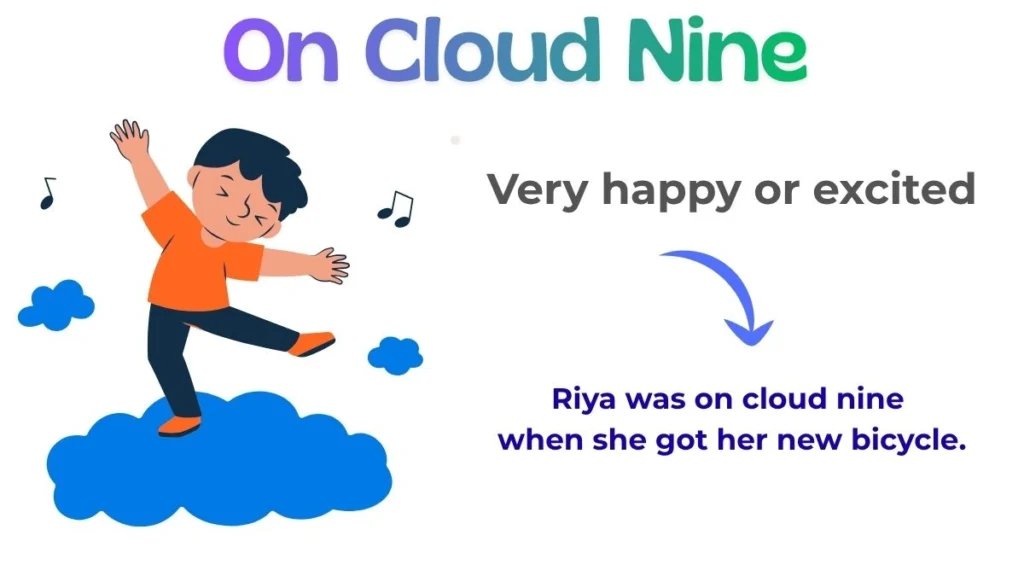
On Cloud Nine
This means extremely happy.
Example: He was on cloud nine after winning the contest.
Every Cloud Has a Silver Lining
This means something good can come from something bad.
Example: Missing the bus helped me meet a new friend—what a silver lining!
A Storm in a Teacup
This means getting upset over something small.
Example: Their argument was just a storm in a teacup.
Break the Ice
This means to start a conversation.
Example: The teacher told a joke to break the ice.
Take a Rain Check
This means to delay something.
Example: Let’s take a rain check on our picnic.
Calm Before the Storm
This means quiet time before something busy or stressful.
Example: The classroom was quiet—the calm before the storm.
Throw Caution to the Wind
This means to take a risk.
Example: She threw caution to the wind and tried the new game.
Snowed Under
This means having too much to do.
Example: I was snowed under with homework last night.
Steal My Thunder
This means taking attention or praise away from someone.
Example: She stole my thunder by showing her project first.
Body-Parts Idioms for Kids
Keep an Eye On It
This means to watch something carefully.
Example: Keep an eye on the puppy while I’m gone.
Cold Feet
This means feeling nervous.
Example: I got cold feet before my performance.
Head in the Clouds
This means daydreaming.
Example: He had his head in the clouds during class.
Butterflies in My Stomach
This means feeling nervous.
Example: I had butterflies in my stomach before my speech.
Break a Leg
This means “good luck.”
Example: Break a leg at your play tonight!
All Ears
This means listening carefully.
Example: When the teacher spoke, the class was all ears.
Pain in the Neck
This means something annoying.
Example: The broken zipper was a real pain in the neck.
Face the Music
This means to accept the consequences.
Example: I had to face the music after breaking the vase.
On the Tip of My Tongue
This means you can almost remember something.
Example: The answer is on the tip of my tongue.
Put Your Best Foot Forward
This means to try your hardest.
Example: Put your best foot forward on the project.
School Idioms for Kids
Hit the Books
This means to study.
Example: I have to hit the books for tomorrow’s quiz.
Pass With Flying Colors
This means doing something very successfully.
Example: She passed her test with flying colors.
On the Same Page
This means everyone understands the same thing.
Example: Let’s make sure we’re all on the same page before we begin.
Put On Your Thinking Cap
This means to think carefully.
Example: Put on your thinking cap for this riddle.
Teacher’s Pet
This means a student who gets extra attention.
Example: He’s not the teacher’s pet—he just works hard.
Learn the Ropes
This means learning how to do something new.
Example: It took me a week to learn the ropes in my new class.
Know the Drill
This means knowing what to do next.
Example: It’s cleanup time—you know the drill.
Back to Square One
This means starting over.
Example: We lost our work and had to go back to square one.
The Sky’s the Limit
This means anything is possible.
Example: Keep practicing—the sky’s the limit!
Make the Grade
This means meeting expectations.
Example: Study hard if you want to make the grade.
Nature Idioms for Kids
Tip of the Iceberg
This means only a small part of something bigger.
Example: The mess in the kitchen was just the tip of the iceberg.
Barking Up the Wrong Tree
This means blaming the wrong person.
Example: If you think I took your notebook, you’re barking up the wrong tree.
Fresh as a Daisy
This means feeling refreshed.
Example: She woke up fresh as a daisy.
Out of the Woods
This means out of trouble.
Example: After my fever went away, I was finally out of the woods.
Go With the Flow
This means relaxing and letting things happen naturally.
Example: I decided to go with the flow during the field trip.
Make Waves
This means causing a disturbance.
Example: Try not to make waves during group time.
As Free as a Bird
This means feeling carefree.
Example: I felt as free as a bird on summer break.
The Grass Is Always Greener
This means thinking others have it better.
Example: Don’t think the grass is greener—your life is great too.
Color Idioms for Kids
Green With Envy
This means very jealous.
Example: She was green with envy when she saw my new bike.
Tickled Pink
This means very happy.
Example: I was tickled pink with my birthday present.
Once in a Blue Moon
This means something rare.
Example: We only get a snow day once in a blue moon.
Out of the Blue
This means suddenly.
Example: Out of the blue, the fire alarm rang.
Caught Red-Handed
This means getting caught doing something wrong.
Example: He was caught red-handed eating the last cookie.
White Lie
This means a small lie to avoid hurting someone.
Example: I told a white lie so she wouldn’t feel bad.
Age-Appropriate Idioms for Kids (Grades K–5)
To make this article even more helpful, here’s a grade-specific guide used by many North American teachers.
Kindergarten & Grade 1 Idioms
Use only the simplest idioms:
- A piece of cake
- Hit the hay
- Break the ice
- Couch potato
- Under the weather
- Butterflies in my stomach
Grades 2–3 Idioms
Kids can now understand slightly more abstract idioms:
- On cloud nine
- Kill two birds with one stone (use gently)
- Hold your horses
- A tough cookie
- Break a leg
- In hot water
- The last straw
Grades 4–5 Idioms
Older kids grasp deeper figurative meanings:
- Barking up the wrong tree
- Out of the woods
- Make waves
- Back to square one
- Go the extra mile
- Level playing field
- A silver lining
- A fair-weather friend
- Caught red-handed
Additional Idiom Examples for Kids (Sentence Expansion)
Here are 20 more sentence examples to enrich understanding:
- “Mom said I was full of beans because I couldn’t stop running around.”
- “You’re as busy as a bee today!”
- “Let’s take a rain check on the park; it’s too cold outside.”
- “He felt out of the woods once his project was done.”
- “Don’t be a copycat — use your own ideas.”
- “I was all ears when the teacher explained the rules.”
- “She spilled the beans about the surprise trip.”
- “You’re walking on thin ice if you don’t clean your room.”
- “The new student felt like a fish out of water.”
- “You need to step up to the plate and try your best.”
- “That’s the icing on the cake — great job!”
- “Once in a blue moon, we get a snow day in April.”
- “You caught me red-handed eating the last cookie.”
- “They were two peas in a pod during group work.”
- “I can’t decide — I have mixed feelings.”
- “Slow and steady wins the race, especially with reading.”
- “The magic show cracked me up.”
- “Don’t let setbacks break your spirit.”
- “That puzzle was tough, but you didn’t throw in the towel.”
- “Let’s call it a day and finish tomorrow.”
These examples help enrich your article and make it more complete for SEO.
More Common Idioms for Kids in U.S. & Canadian Culture
Children in North America often encounter idioms in:
- Storybooks
- School conversations
- Cartoons
- Sports commentary
- Family life
- Classroom instructions
Here are additional idioms commonly heard in U.S. schools:
- “Give it a shot” — try something
- “Hit the books” — study
- “Pull yourself together” — calm down
- “Hang in there” — don’t give up
- “The ball is in your court” — it’s your turn to decide
- “Go the extra mile” — do more than expected
- “Practice makes perfect” — keep trying
Example sentences:
- “Give it a shot — you might enjoy the science fair.”
- “Let’s hit the books. The test is tomorrow.”
- “Hang in there! You’re almost done.”
- “You need to pull yourself together before class starts.”
These idioms help students understand everyday communication in their environment.
FAQs About Idioms for Kids
1. What is the idiom definition for kids?
A phrase whose meaning is different from the literal meaning of its words.
2. Why are idioms important for children?
They improve vocabulary, reading comprehension, and cultural understanding.
3. What are the easiest idioms for kids?
“A piece of cake,” “Hit the hay,” “Break the ice,” and “Couch potato.”
4. Are idioms used in children’s books?
Yes, especially in American and Canadian children’s literature.
5. How can parents practice idioms at home?
Use them in daily sentences and ask kids to guess the meaning.